
Disarmed
Chapter I: The Chortle of Njörðr
“If you can sail here, you can sail anywhere.”
- Every sailor in Puget Sound
There was a lot of excitement leading up to the 2024 Viking Fest in Poulsbo, Washington. Not only is it one of the most popular Viking-themed events in the area, but it was also only our second major event with the boat—and our first time really getting to sail her.
We had spent the winter into the spring getting her prepped: checking for leaks, fixing what needed fixing, and restoring her to seaworthiness.
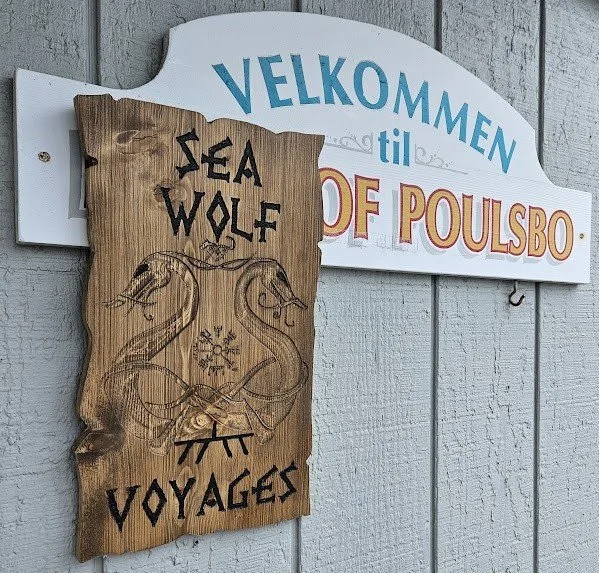
Once we had arrived in Poulsbo, set up our museum and launched the boat we spent all three days sailing as often as we could.
Many of our friends from the NW Viking Alliance were there, as well as the Glamfolk who had run the village of A-frame tents in the park at Viking Fest for 30 years.
The port manager was kind enough to let us use the seaplane dock right in front of the park where they were set up.
We made sure to give as many of them rides as possible, which felt like coming full circle after so many of them had supported us in getting to this point. It also meant that every time we went out, it was with a full boat of historically accurate Vikings who were all excited to be there.
It was awesome.
We made sure to give as many of them rides as possible, which felt like coming full circle after so many of them had supported us in getting to this point. It also meant that every time we went out, it was with a full boat of historically accurate Vikings who were all excited to be there.
It was awesome.
After a few successful—albeit nerve-wracking—returns, we set out again that first afternoon in some very lazy five-knot winds.
On board for this particular trip were Bjarke, our Gothi and lead Holumenn; Hrafna, who was 18 at the time but had been sailing with their grandfather since they were eight; Thorolf, a Navy veteran and member of the Glamfolk; Baldr, our youngest crewmember and, at 16, already a masterful welder; Velent, known to us as Bloodeye and an SWV Board Member who founded and runs Northwest Shieldwall; his little but fierce affenpinscher, Mitsy; and myself, Særulf.
Finding that we had good wind and could tack all up and down Liberty Bay, we decided to stretch the Sieann’s legs a little farther than we had up to that point.
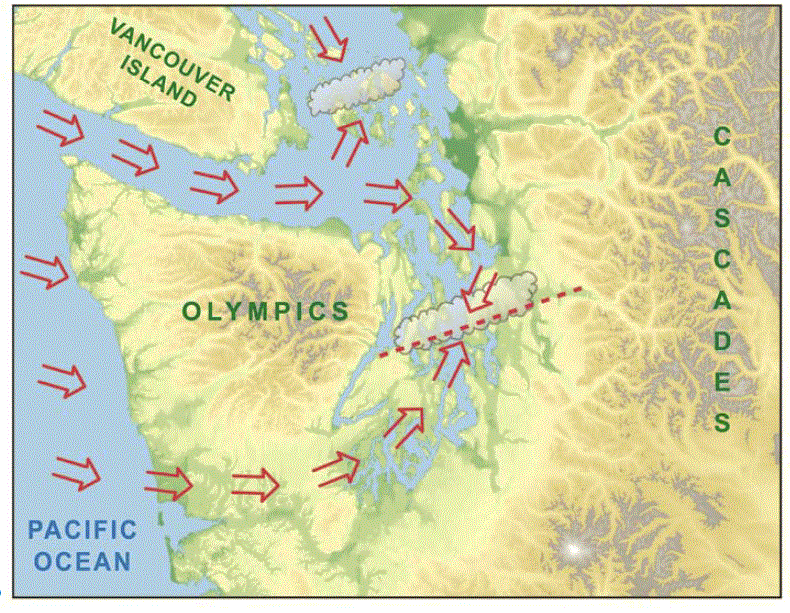
Now, pretty much every sailor I’ve met in Puget Sound has said that, “If you can sail here, you can sail anywhere.”
That’s partially because wind and weather coming in off the Pacific gets split north and south around the Olympic Mountains, trapped by the Cascade Range to the east, and are pushed back together—creating an ever-present, ever-changing convergent zone in Puget Sound. The result is all manner of regular, fickle wind and weather conditions.
That’s one reason.
We’re also convinced it has something to do with the fact that the Norse god Njörðr—who is associated with wind, sea, and seafaring—has a wonderful sense of humor.
So it should have been of a surprise that, at our furthest point from port, just as we were attempting to tack back, the wind suddenly rose from five to fifteen knots.
As whitecaps began forming on the waves, we quickly realized we were caught in a rising offshore wind, pushing us away from port.
It wasn’t just the wind that turned on us either—the wind and current worked in tandem, pulling us toward the remains of a dilapidated dock on a rocky shore less than half a mile away.
None of this would be an issue for a larger boat by any means, but keep in mind the Sieann is only twenty feet from stem to stern and incredibly heavy for her size. Though her length allows her to turn on a dime and her five-foot beam makes her comfortable on deck and ride higher in the water, it also makes successfully tacking her an art form unto it’s own.
And we were finding all of this out today.
Using a combination of the oars and sail, we fought the elements. The crew swapped from the styrboard, rowing and out while Hrafna and I tried to control a thrashing sail with the sheets alone. and maybe even get some kind of propulsion away from the broken dock and the rocks.
It was no use.
The wind only worked to push us closer to harm, so we decided to bring the sail down to take it out of the equation. It was in that moment that we got one of our first—and best—lessons in square-rigged sailing.
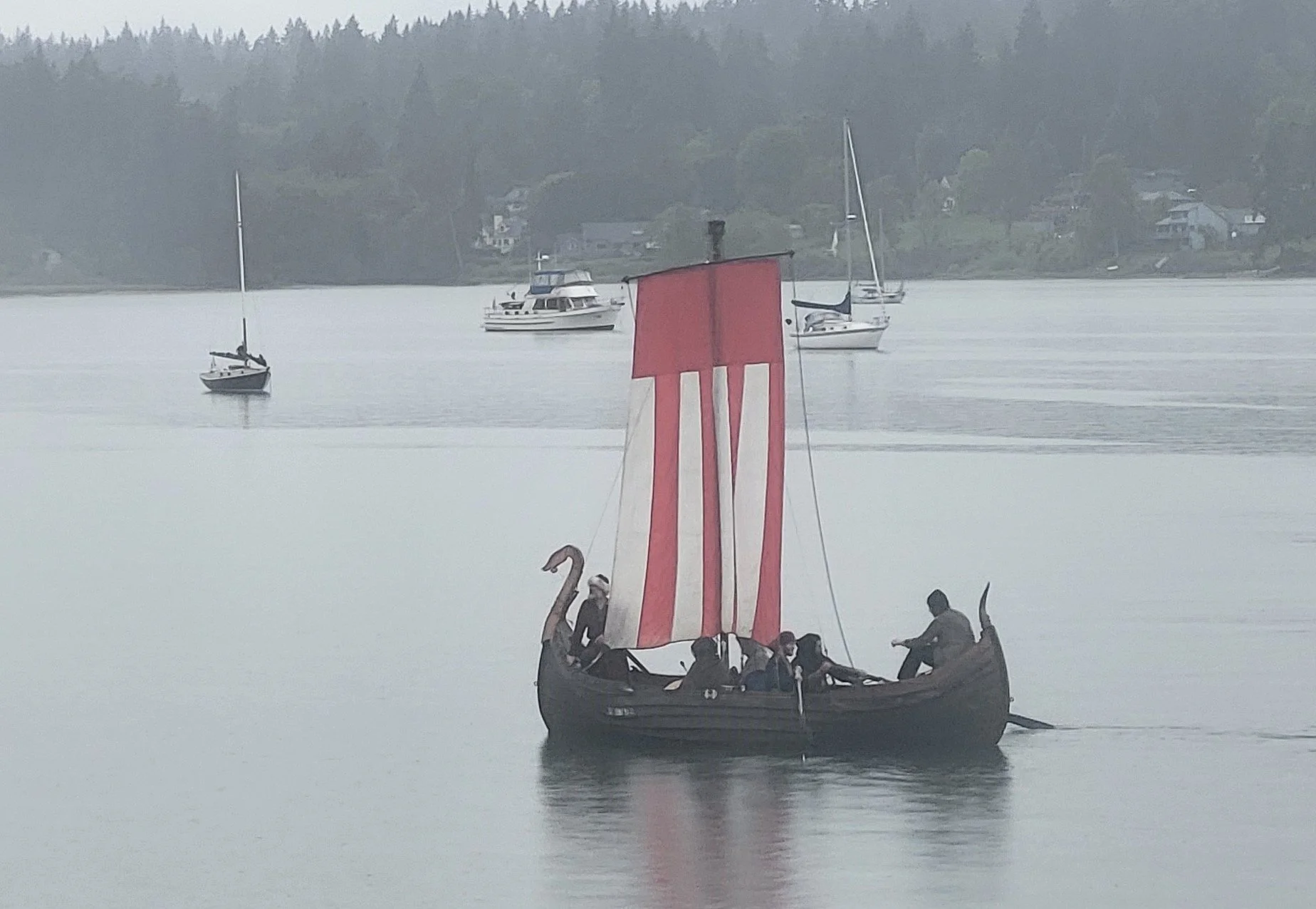
A sudden, merciless gust kicked up and our hollow aluminum yardarm—the spar or beam that holds the sail perpendicular to the mast and which had originally been installed in the 1970s—flailed and thrashed and, after decades of exposure to salty sea air, slammed hard against the mast…
…and snapped in half.
A hush fell over the boat.
Only for a moment—but it was palpable.
It’s important to note here that we did not get a motor with this boat when it was donated to us. Moreover, we had been confident that oars and sail would be enough, since we were just cruising around the bay. Let’s just say it was a weekend of learning and firsts, and we knew that going in.
A moment later, the crew hopped to.
The remaining oarsmen kept rowing while Hrafna and I fought to bring the sail and broken yardarm down without impaling anyone aboard.
After a bit of struggle to find a working phone, we called the Coast Guard for a rescue—and then our friends, to let them know why we weren’t back yet.
While bringing the sail down, and with fewer people rowing, we drifted until we were about 200 feet from the dilapidated dock and roughly 350 feet from the rocks.
We spent more than half an hour rowing against the current in that spot without making any headway.
Just as we were starting to look for the least damaging place to bring in the boat, we noticed a mini-yacht headed our way from the Sound. The mariners on board saw our struggle and came to our rescue like absolute professionals.
They brought their boat around to our windward side, blocking the wind, tied our boat to theirs, and took all souls but Hrafna and myself on board. They then took our bowline and got set to tow us in.
The second we got tension in the line and they started towing us, the cavalry arrived.
Herger of the Glamfolk, along with a few others from our collective village, had talked the owners of a ski boat into coming out to rescue us.
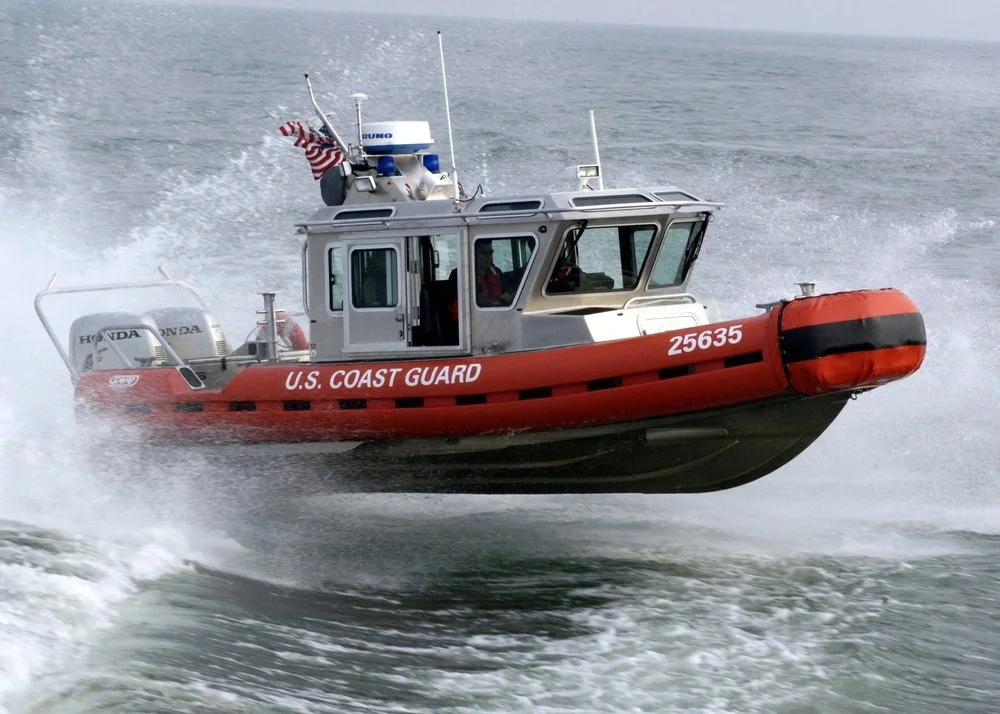
Just as we were yelling and waving at them, a Coast Guard response boat arrived and escorted us all back to the docks.
It was Nauta Ex Machina, and all within a few minutes.
On the Sieann, Hrafna and I were quiet. We were shaken, embarrassed, and pissed off.
We seemed to come around at the same moment though, when—just as I was about to say something to comfort my young crewmate—Hrafna, yelling over the mini-yacht’s motors, turned around and used what were going to be my own words to comfort me:
“You know, we’re gonna laugh about this in 20 years.”
The subject of time instantly made me think about the immediate reaction of our friends onshore… and then about all the horns of mead they were likely already preparing to hand us.
“We’re gonna to laugh about this in 20 minutes.”
I turned to the Coasties in the Response Boat, who were keeping pace just off our port quarter, and held my hands up in a “taking a picture” pose.
“Are you guys getting some good shots?” I yelled sarcastically, but there was no hearing me over the symphony of outboard motors.
One of the Coasties pulled out his phone and started taking pictures. Hrafna and I got a much-needed laugh out of that. Though I’ve tried, I still haven’t seen those photos.
It was only funny to us at the time for obvious reasons, but that little bit of levity was how we snapped ourselves out of survival mode, gave ourselves permission to breathe, and started thinking about what came next.
Continued in Chapter II…
